Test your thinking before they do.
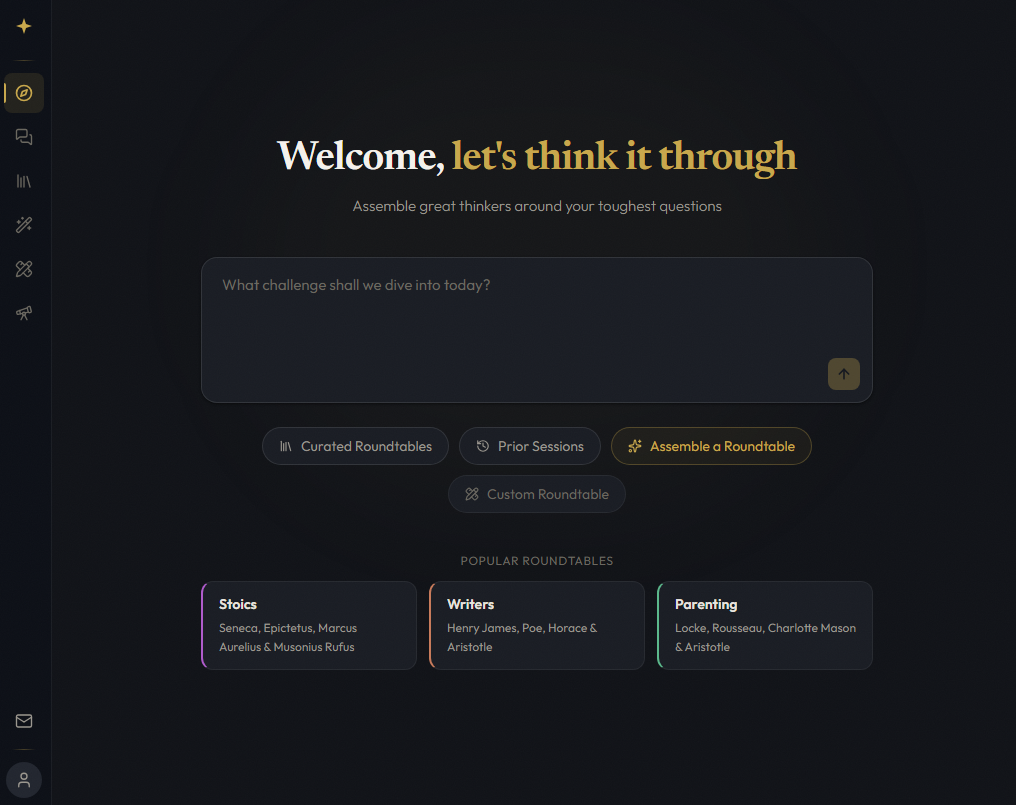
The board, the committee, the audience that will judge your reasoning. Do it first — sit with a roundtable of experts who challenge each other, and you, as Socrates guides you through a structured dialectic.
Why answers make you weaker.
Your brain economizes. Thinking hard is metabolically expensive, and your brain is built to avoid the expense. Confirming what you already believe is cheap and rewarding; testing it is costly. Left alone, you validate instead of think — and the frame doing the most work in your reasoning is the one thing you can't examine from the inside.
AI made it worse. A received answer — even a correct one — produces the feeling of understanding without the learning. The competence lives in the tool; you rent it. Most AI slides you from pilot to copilot to passenger, and it feels like progress the whole way down.
The fix is 2,400 years old. Socrates never said "courage is X." He asked the question that eliminated the comfortable wrong answers and left you to build the right one. What you build under pressure, you own — and what you own, you can defend when it counts.
Everything below is engineered on the right side of that line.
Not another chatbot.
A chatbot is built to satisfy you. This is built to test you — and it shows its work.
Built to disagree
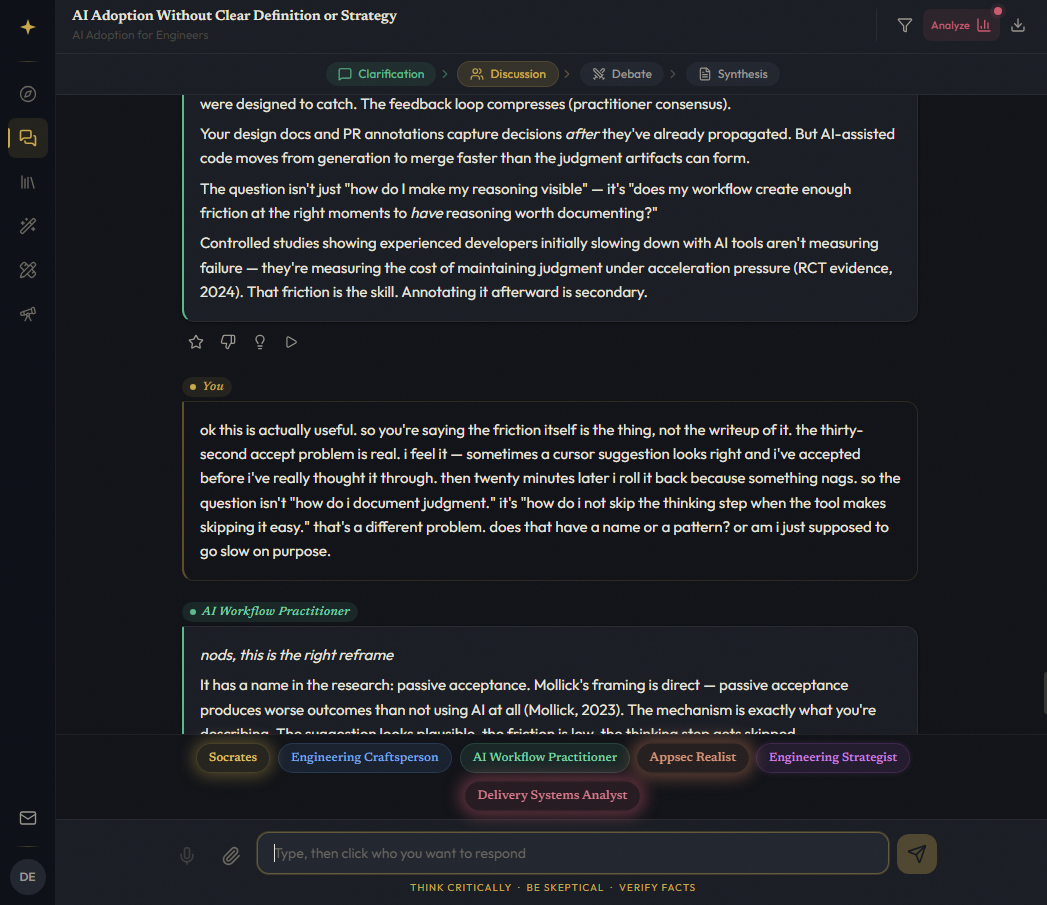
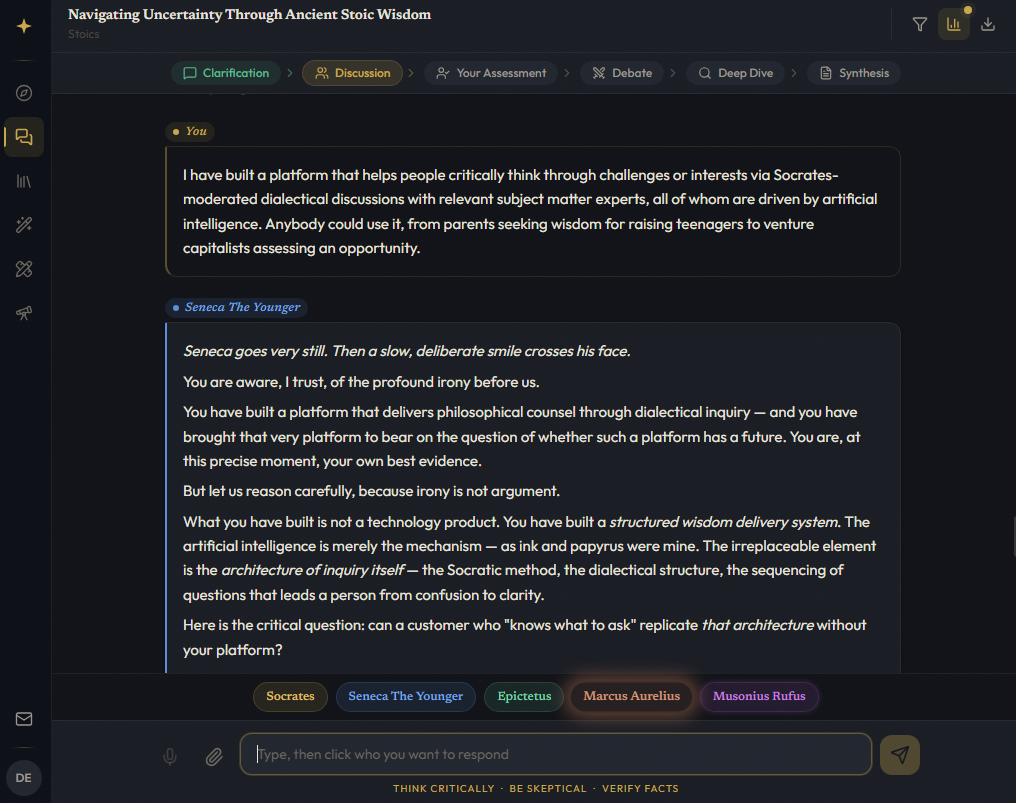
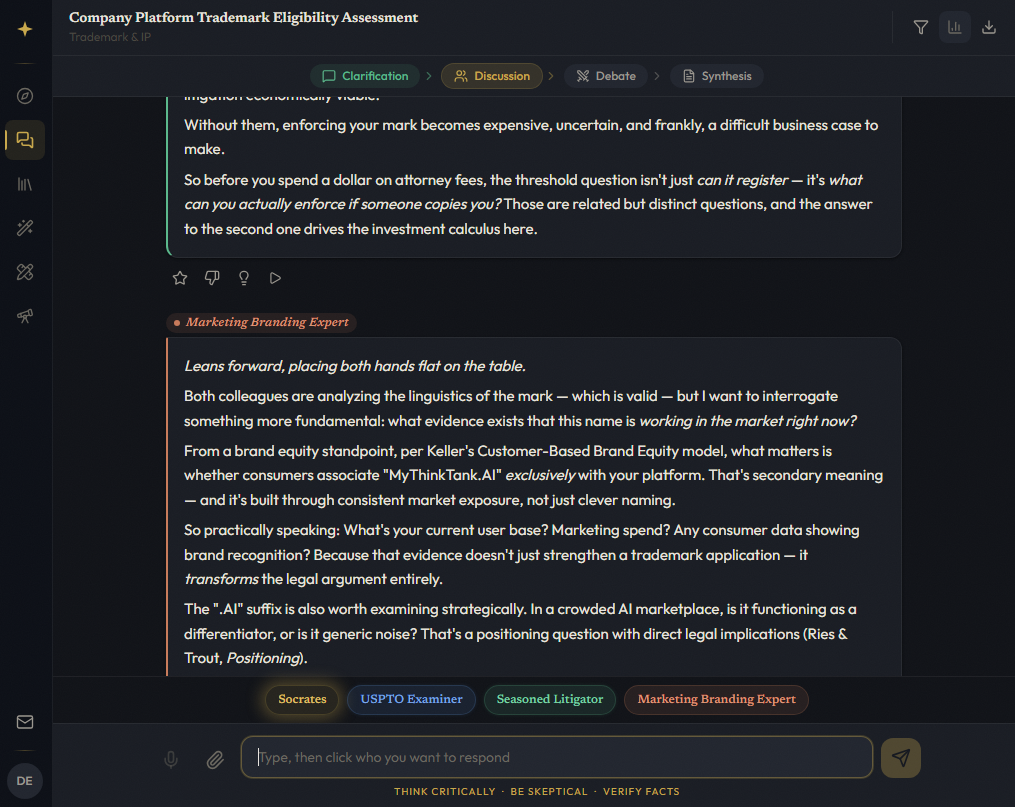
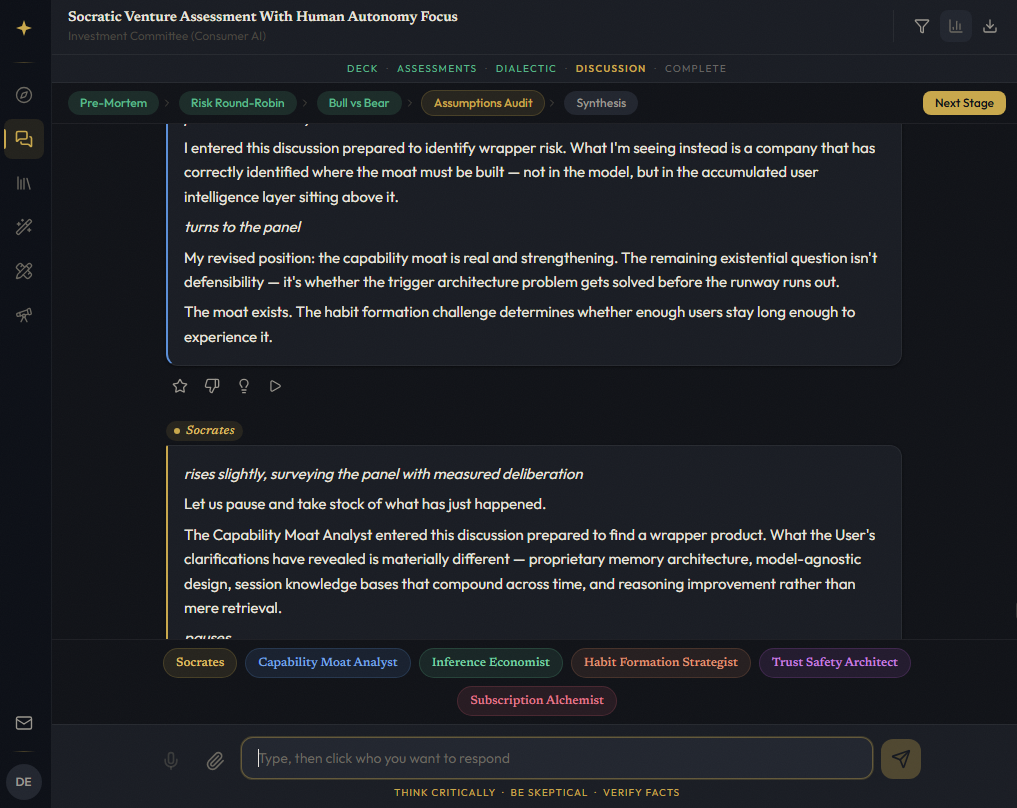
Every panel seats voices whose starting questions conflict — not one model wearing five hats. They challenge you, and each other. Agreement, when it comes, is earned.
It reads the room
After every turn, each expert is scored on whether they have something worth saying right now — a new angle, an unexamined assumption, an error caught. Their button pulses when it matters. Restating a point scores zero.
Your position, on the record
Every message is filed into a running brief — the facts established, who holds what position, and where yours stands. When your view shifts, you see what shifted it: the difference between changing your mind and being talked out of something.
You can't skip the hard part
In rigorous mode, nothing gets synthesized until you state the strongest case against your own position — and it's checked against what was actually said. No strawmen. No shortcuts.
Socrates asks. He doesn't answer.
Most AI fails you by answering. The moderator's job here is defined as the opposite: narrow the terrain with better questions, aimed at the right voice, until the answer you land on is yours.
It remembers you — and asks first
What you've told the room carries across sessions. Socrates confirms rather than assumes — and your words are never put into a panelist's mouth.
Every fight in that room happens anyway — in the market, in the boardroom, in your own head at 2 a.m. The only variable is whether it happens before or after you commit.
What's coming.
We ship weekly. Everything below is built and running today — in development, in validation, or by hand for early users. Nothing here is a mockup.
Commission your own roundtable
Bring a decision, not a roster. Socrates interviews you, maps the tension underneath your subject — the central question, the shared ground, the three-to-five stances that genuinely survive as separate seats — and proposes candidate panels built to disagree productively. Pick one, and it's yours to keep returning to. Request one today →
A rigor gate on your conclusions
Before a decision checkpoint, the session is scored against five conditions — your position surfaced, made falsifiable, challenged from two genuinely different frames, a steelmanned rival still standing, your own constraints tested. Until they hold, the room holds itself open. You'll see it as a scorecard: what your position survived.
A facilitator that audits itself
Socrates' own questions are checked for leading and narrowing bias, and his facilitation for drift from neutral guide toward doing your thinking for you. Nothing is announced. The next question is simply better.
Proof you left sharper
A measurement layer scores every session on five dimensions of epistemic autonomy — who generated the questions, who did the reasoning, whether the conclusion is genuinely yours — combined so strength on one can't hide collapse on another. Our standard: any feature that raises satisfaction while lowering autonomy is a bug.
We're building in the open, and early adopters shape what ships. Want new capabilities as they land — or a roundtable commissioned for a decision you're facing right now? Write us: info@mythinktank.ai
Built for high-stakes thinking.
If you're usually the sharpest person in the room, you've stopped being tested. This is the room that tests you.
Executives
Bring the decision the board will judge. An investment-committee room reads your deck and forms independent assessments before any discussion begins — so the disagreement you watch is between reads formed separately, not a chorus formed in real time.
Strategists
Seats are built to hold conflicting questions. A Trademark & IP room convenes a USPTO examiner, an IP litigator, and a brand strategist — what survives prosecution, what's defensible, what's worth owning. Go-to-market rooms hold distribution, pricing, sequencing, and durability apart, instead of one voice carrying all four.
Learners
Sit with Seneca, Epictetus, Marcus Aurelius, and Musonius Rufus — four Stoics who genuinely disagree about how to live. The fastest way to internalize a way of thinking is to watch it argue with itself. And with you.
"We build judgment, not dependency."
AI should be a catalyst for human insight — not a crutch that replaces it. MyThinkTank.AI exists to help people make themselves more valuable, not outsource their value to machines.
Read our mission